Sessions and Players


Sessions and Players

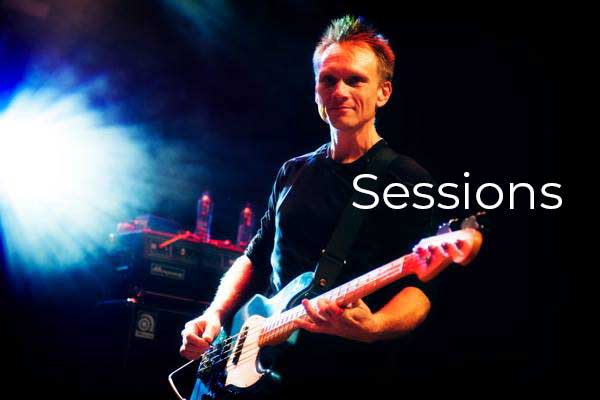
I love playing bass.


I’ve been lucky to get called for recording sessions for some great artists and composers over the years, which has given me the opportunity to play both electric and upright bass in countless situations, including sessions for TV and film. I have a home studio from which I can produce electric and upright sessions, utilizing through a great sounding Manley tube pre-amp, along with a number of other accouterments to color and shape my sound to your liking.

Below are a number of bass sessions featuring me on electric and upright bass playing in a number of styles, from jazz to pop to show tunes. Among them are sessions that were recorded at my home studio and added to the session remotely. These sessions highlight not only me, but the playing, composing, and production skills of a number of the incredibly talented and hard working people that I’ve had the opportunity to play and perform with.

Playing Sessions


My concept of how to play bass has evolved over the years. For pop playing, the goal for me has almost always been how to be “invisible.” My feeling is that the role of the bass is that of a foundation, much like the foundation of a house. Everything is built upon it, everything relies on it, but you’re not really supposed to notice it. Not consciously at least. I feel that my job is to leave no holes for the groove to fall through. It’s funny...at this point, I’m not sure I can describe how I do that, but I feel it. I’ve been doing it long enough to just know what to do to make sure everyone is completely supported.

When I first started playing, it was about playing simple, repetitive lines. I was never much into being a “chops” guy. It was more fun for me to make things feel as solid as possible. However, I have found that simple isn’t necessarily the key. Overly simple bass playing can sometimes make the music feel too plodding. There are lot of very subtle things that I have found can be done to exploit and highlight moments of drama in the music, or rather, moments where there should be drama.

Sessions and Players

Again, these are things that most listeners would never be aware of on a conscious level, but I have found that these moments are an integral part of a good groove. So, as my playing developed, I realized that I could create the effect of playing a repetitive bass line without actually being repetitive. I found that I could highlight transitions in the music, leave a hole for a moment, just to set myself up to do something...usually something stupidly simple, that gave the transitional moments of the music just the right little lift that it needed.

So, playing simple, repetitive bass evolved into sounding like I was playing simple repetitive bass, without actually doing so, and interjecting very simple, very subtle variations into the groove to create forward movement, and a sense of tension and release.

The role of the bass is that of a foundation, much like the foundation of a house. Everything is built upon it, everything relies on it, but you’re not really supposed to notice it.

As I began to get more session work, I started to be able to recognize the mindset I was in when I nailed a take. When I was younger and more inexperienced, it took more takes, but as I got a little older, I started to recognize how I had to think and feel in order to play a good bass part in the studio. First of all, for me, the studio is a different mindset from a live performance, and therefore I think that the way one plays in the studio is different from the way one plays live. I think that playing live is more about creating a certain kind of energy and excitement and risk. It’s a high wire act, in a way, and it’s even ok when the guy on the highwire wobbles a little. In fact, it’s kind of exciting to see that struggle. It’s an interesting kind of tension. In the studio, however, I feel that it’s more of a construction project. It has to be exciting and full of energy, but it has to be very firm.  Almost perfect.


Therefore, for me, the studio mindset is something like meditation. It’s like I’m not there, if that makes any sense. I’m listening to the click, and I’m not trying. I’m just not trying to do anything. At the time of the performance, it often feels like too little. If I just groove to the click and get out of the way, nine out of ten times I listen back, and there it is. It’s a weird thing to explain, but, I know that now, when they hit the record button, I feel really cozy and comfortable, in fact, I love burying a click.

My Players


Now I’d like to give credit to a lot of the players from the clips on my sessions page. I’ve been fortunate to play with some of the best musicians in Los Angeles over the last twenty years, and as a result, these professional musicians and studio players are available to me (and you) for almost any gig. See the bios and links below for some of the best players around. If you need jazz, pop, or rock players, I can assemble a top-notch band for you, call on the best players, and manage the process from beginning to end. Of course, you can click on any of the links below and contact any of these players yourself. There is no one on this page that doesn’t deliver.

Leave a Reply

Your email address will not be published. Required fields are marked *

You may use these HTML tags and attributes: <a href="" title=""> <abbr title=""> <acronym title=""> <b> <blockquote cite=""> <cite> <code> <del datetime=""> <em> <i> <q cite=""> <strike> <strong>